Assoc. Prof. Desislava KOLEVA, MD
Associate Professor Desislava Koleva, MD, is a renowned vitreoretinal specialist with extensive experience in the surgery of severe eye diseases – Retinal detachment, macular holes, vitreous haemorrhages, diabetic retinopathy, eye injuries, and other posterior segment eye diseases that are difficult to diagnose and treat.
She has numerous specialisations and courses in Bulgaria and abroad. She obtained a specialisation in
Ophthalmology in 2006. In 2010 – a Diploma from the European Board of Ophthalmology (EBO). In 2012 – a Diploma for a Doctor of Ophthalmology educational and scientific degree after defending her doctoral dissertation on the topic: “Clinical evaluation of diabetic macular edema using spectral optical coherence tomography”. And in 2018 – a Habilitation Diploma – Associate Professor of Ophthalmology.
Associate Professor Koleva consults and performs surgical treatment for cataracts, including complicated cataracts, as well as combined eye surgeries. She works in several eye medical facilities. She is the manager of “Assoc. Prof. Desislava Koleva -“St. Luke” Ltd., Plovdiv. She performs consulting and surgical activities as an ophthalmologist at MC “Vereya” Ltd., Stara Zagora, in the ophthalmology department at MBAL "Trimontium” Ltd., Plovdiv, in the Clinic of Eye Diseases at UMBAL “St. George” EAD. She is a lecturer at Medical University – Plovdiv.
As an eye doctor, I see hundreds of patients every year who come with the same fear in their eyes: “My vision is
getting worse… Is this macular degeneration?”
The truth is, macular degeneration doesn’t appear suddenly. It starts quietly, slowly, almost imperceptibly.
First, we lose contrast. Then, in the centre of vision, letters start to “blur”. Faces become harder to recognise. And most importantly — this process can be slowed down. But only if we protect the macular pigment — the eye’s natural shield.
– Assoc. Prof. Desislava KOLEVA, MD
What actually happens to the macula? The truth that few patients know:
The macular pigment is composed of three carotenoids: lutein, zeaxanthin, and meso-zeaxanthin. These molecules act as a “yellow filter” that stops blue light and as an antioxidant shield that protects the finest part of the retina. After the age of 25, the macular pigment begins to thin — by an average of 1% each year. This was established in a study with 800 volunteers (1. Nolan et al., 2006).
Who is most at risk?
According to the study by Nolan et al., 2006, the following factors reduce macular pigment density: age, smoking, female gender, and family history of macular degeneration.
Why are the three carotenoids so important?
Macular pigment is a complex three-component structure, where each carotenoid has a precisely defined place — like perfectly arranged tiles on a shield that protects the most valuable part of vision – the macula.
Lutein
the outer protective layer – Lutein accumulates predominantly in the more peripheral parts of the macular
pigment. It acts as an “outer filter” that first intercepts and blocks blue light.
Zeaxanthin
the middle layer, the zone of fine vision – Zeaxanthin concentrates in the intermediate zone of the macula, the area that supports detailed and contrast vision. It is optimised for absorbing light in the range where photoreceptors are most vulnerable.
Meso-zeaxanthin
the heart of the system, the central “crown” – Meso-zeaxanthin is found in the very centre of the macula — the fovea. This small area is responsible for the sharpest detailed vision, for recognising faces, reading text, and close-up work. It is precisely there that the eye is most vulnerable. And it is precisely there that the carotenoid with the strongest antioxidant activity — meso-zeaxanthin — is found.
How do the three work together?
Their combination is not a mechanical sum of three substances — it is a biological synergy, proven in both preclinical and clinical models:
1. They cover different ranges of the light spectrum
Each carotenoid absorbs blue light in a slightly different range. Therefore, the triple combination protects against a wider spectre of harmful light.
2. They create a uniform “photoprotective filter”
Because they are spatially separated into three con- centric layers, they form a complete three-dimensional shield that has no “weak spots”. If even one of them is missing, there is a hole in the shield – especially in the centre.
3. They work as an antioxidant team
Meso-zeaxanthin is the most powerful antioxidant, but it is further activated in the presence of lutein and zeaxanthin. The three mutually regenerate and reinforce each other, leading to: a stronger neutralising effect against free radicals, faster stabilisation of macular cells, and a greater increase in macular pigment.
4. They cover all three anatomical zones of the macula
This is the key: without all three together, the natural structure of the macular pigment, as nature created it, can never be achieved.
The three together form a complete protective shield, not partial protection.
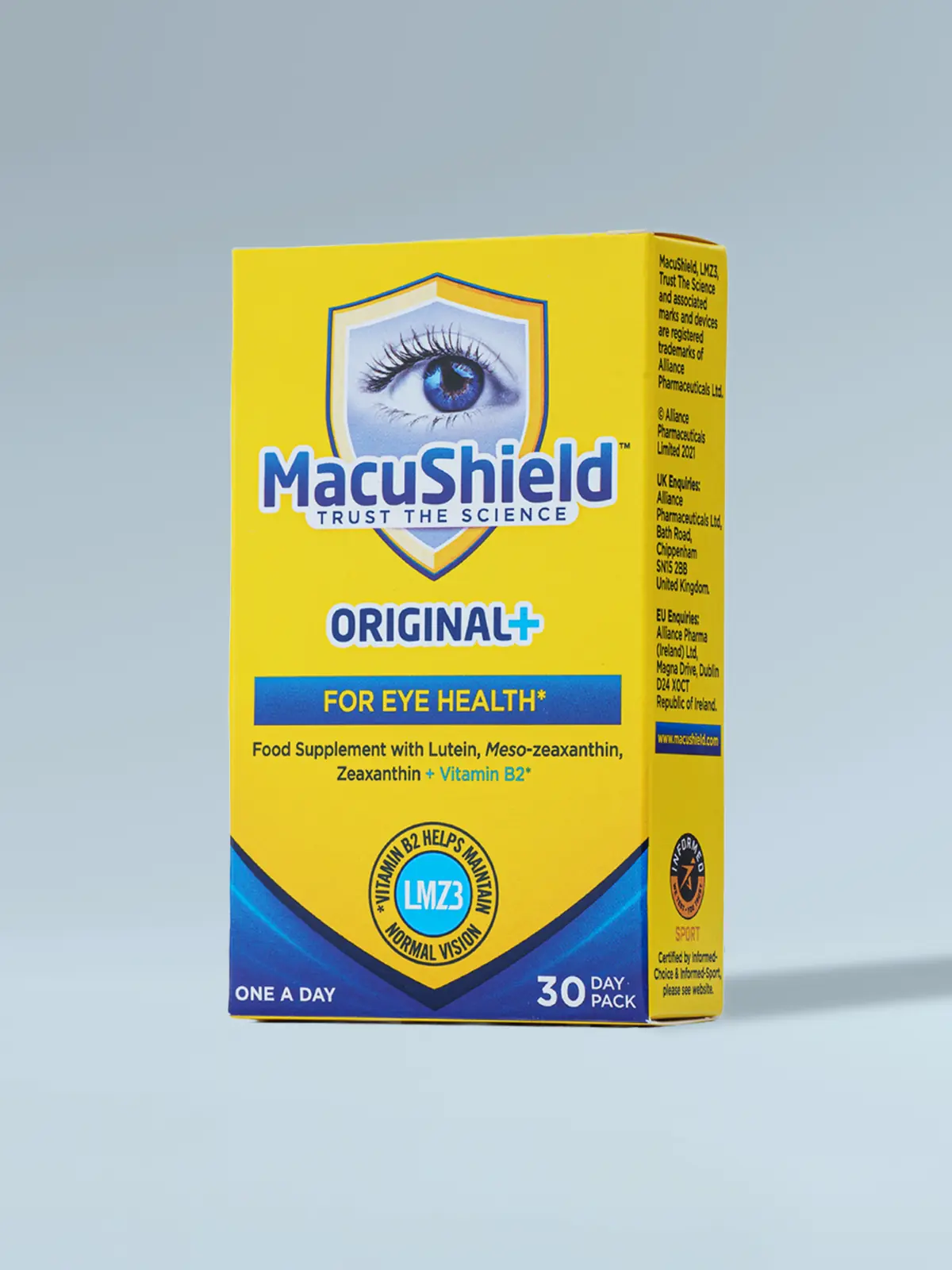
That is why a product like MACUSHIELD, which uniquely contains all three carotenoids, has the strongest effect on: increasing macular pigment, improving contrast sensitivity, slowing the progression of macular degeneration, and protecting central vision.
And the most important question is: how do we restore this protective pigment?
For years, patients took so-called “eye vitamins” based on lutein, vitamin A, and zinc. Today, science shows that these formulas are no longer sufficient, and sometimes even risky. According to Hoang & Tolentino, 2016, ref.3, outdated formulas with vitamin A and zinc should be replaced with the triple combination: meso-zeaxanthin, lutein, and zeaxanthin, such as MACUSHIELD.
The large clinical study CREST AMD
The CREST AMD study (2. Akuffo, Beatty, Peto, Nolan et al.,2017) shows that the triple combination significantly
increases macular pigment density, improves contrast sensitivity, reduces glare sensitivity (photophobia), and slows the progression of the disease. Even more impressively, within two years, not a single patient in the group receiving the triple combination progressed to a more severe stage of the disease. The authors’ conclusion is unequivocal:
“Regular intake of a triple combination of carotenoids such as MACUSHIELD in patients with non-advanced age-related macular degeneration leads to significant increases in macular pigment density, improvement in contrast sensitivity, and other indicators of visual function.”
This means one thing: MACUSHIELD not only nourishes the macula but also offers a real chance to preserve vision longer and slow the progression of the disease.
Conclusion
Macular degeneration is a slow erosion, and science is unequivocal. MACUSHIELD – the only triple combination of lutein, zeaxanthin, and meso-zeaxanthin is the most effective approach to protecting the macula.
MACUSHIELD is the standard for modern prevention of macular degeneration. The earlier we start, the more vision we preserve. Macular degeneration is a challenge, but not a sentence.